
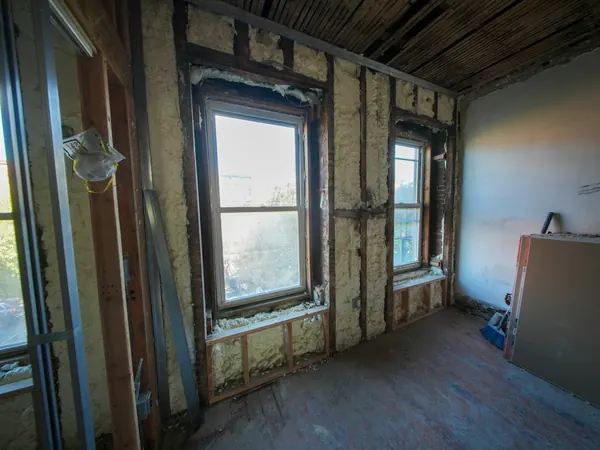
Signs that a building needs structural drying
If water reached drywall, carpet pad, wood flooring, or the framing behind them, the structure needs mechanical drying even after the visible water is gone.
The signs show up over days. Baseboards swell and separate at the joints. Paint blisters a few inches above the floor where drywall wicked water upward.
Hardwood boards cup, meaning the edges rise higher than the centers. Laminate lifts at the seams. Interior doors start to rub.
The room feels clammy and the windows fog. A musty odor after 2 or 3 days means microbial growth is starting.
Drywall can wick water well above the level the water actually reached, so the wet zone in a wall is usually taller than the watermark suggests.
Why wet building materials don't dry without help
Evaporation needs 3 things: air moving across the wet surface, air dry enough to accept more moisture, and warmth. A closed room after a leak has none of those working in its favor. The air right at the wet surface saturates quickly and evaporation stalls. Meanwhile the water that did evaporate has nowhere to go, so it condenses on cooler surfaces or soaks into materials that weren't wet to begin with, such as ceiling drywall and the contents of closets.
Professional drying fixes each piece. Air movers strip the saturated layer of air off wet surfaces. Dehumidifiers pull that moisture out of the air and send it down a drain as liquid. Temperature is kept in the range where both work efficiently.
How structural drying is performed
Moisture mapping
We measure moisture content in the wet materials and in a known dry area of the same building. The dry reading is the target. Readings are recorded by location so progress can be compared day to day.
Deciding what stays and what goes
Materials that won't dry in a reasonable time, or that hold contamination, are removed: saturated carpet pad, wet insulation, swollen particleboard, and drywall that has lost its strength.
Opening up trapped moisture
Baseboards come off, toe-kicks under cabinets are opened, and small holes may be drilled to move air into wall cavities. Vinyl flooring and other vapor barriers that trap water against the subfloor are lifted.
Placing equipment
Air movers are spaced along wet walls and across floors. Dehumidifiers are sized to the volume of the space and the amount of wet material. The area is closed off from the rest of the house, and often from outdoor air, to create a controlled drying chamber.
Monitoring visits
We return to take readings, reposition air movers toward the slowest areas, and remove equipment from sections that have reached target.
Verification
The job ends when the wet materials read the same as the dry reference areas. You get the reading log.
Drying hardwood, plaster, and other slow materials
Hardwood floors. Water gets between boards and under them, where airflow across the top can't reach. Floor drying mats or panels sealed to the surface pull air and moisture through the seams by suction. This works best when started in the first day or two.
Plaster on lath. Plaster is dense and releases moisture slowly. Aggressive heat and airflow can crack it or separate it from the lath, so it's dried at a gentler pace with close monitoring.
Cabinets. Water collects in the dead space under base cabinets. Opening the toe-kick and moving air through that void often saves the cabinets. Particleboard cabinet boxes that have swollen won't recover.
Subfloors. Plywood and plank subfloors dry well from above once the floor covering is up. If the underside is covered by wet insulation in a crawl space, that insulation has to be pulled. See crawl space water removal.
How Winston-Salem humidity changes the drying plan
Winston-Salem has a humid subtropical climate, and from late spring through early fall the outdoor air carries a lot of moisture. That has a direct effect on drying. In a dry climate, a contractor can sometimes open the building and let outside air do part of the work.
Here in summer, opening windows brings in air that is already damp, and the dehumidifiers end up drying the neighborhood instead of your walls. So on most jobs from May through September we keep the drying area closed, run the air conditioning if it's working, and rely on dehumidifiers. In winter the outdoor air is drier, and the main concern becomes keeping the space warm enough for the equipment to work.
What affects the cost of structural drying
Drying cost comes down to how much equipment is needed and for how many days, plus the labor to open up, monitor, and remove materials.
- Amount of wet material. More wet square footage means more air movers and dehumidifiers.
- Type of material. Hardwood, plaster, and thick subfloors add drying days. Specialty floor-drying systems add equipment.
- How long it was wet. Deeply saturated framing takes longer than surfaces that were wet for an hour.
- Demolition. Removing drywall, insulation, or flooring adds labor and disposal.
- Layout. Water spread across several rooms, closets, and levels needs more equipment than the same area in one open room.
- Conditions. A building with no working air conditioning in July, or no heat in January, is harder to dry.
When wet walls and floors need urgent attention
Drying is time-sensitive even when nothing is actively leaking. Mold can begin growing on damp drywall paper, wood, and dust in about 24 to 48 hours. Hardwood that might have been saved on day one is often a replacement job by day 5.
Call promptly if materials have been wet for more than a day, if there's any musty odor, if hardwood is visibly cupping, or if the water came from a contaminated source. If the wet area is small, the source was clean, and it happened within the past few hours, a same-day or next-morning visit is usually fine.
What to do while drying equipment runs
- Leave machines on and where they were placed. Tell us before moving one.
- Keep windows and exterior doors closed unless we have asked otherwise.
- Expect noise and warmth. Rooms being dried run several degrees warmer.
- Keep children and pets away from cords and equipment.
- Don't repaint, re-carpet, or reinstall baseboards until final readings are done. Sealing in damp material is how mold problems start.
After the equipment is out, watch the area through the next few weeks. New odors, staining, or flooring movement mean something needs to be rechecked.
Drying is the core of what a Winston-Salem water damage company does. It follows water extraction, and when it's skipped or cut short, the usual result is a later call for mold remediation.
Other services connected to drying
Structural drying questions
How long does structural drying take?
Most clean-water losses in drywall and carpet dry in about 3 to 5 days of continuous equipment operation. Hardwood floors, plaster walls, double layers of drywall, and wet crawl space framing often take a week or more. Moisture readings set the schedule.
Can I turn the equipment off at night?
Please don't. Drying depends on constant airflow and constant dehumidification. Turning machines off for 8 hours lets moisture settle back into materials and can add days to the job.
How much electricity does drying equipment use?
It varies with the amount of equipment. Air movers draw little power each, and dehumidifiers draw more. Expect a noticeable but temporary increase on the electric bill for the days the equipment runs. Some insurers reimburse it as part of a covered claim, so ask your adjuster.
Do walls have to be cut open to dry them?
Not always. With clean water caught early, walls can often be dried by removing baseboards and directing air into the cavity through small holes that the baseboard later hides. Walls with wet insulation, contaminated water, or several days of saturation usually need the lower section of drywall removed.
Will my hardwood floor go back to flat?
Cupped hardwood often flattens considerably once the moisture content of the boards returns to normal, and sanding and refinishing can correct what remains. Boards that have crowned, split, or lifted off the subfloor usually need replacing. Don't sand a cupped floor until it has been verified dry.