
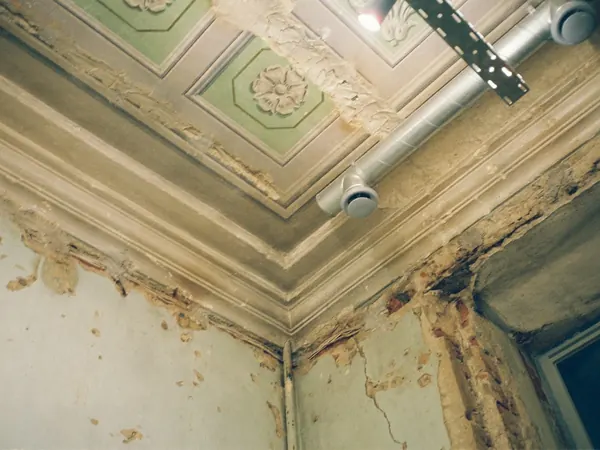
Signs of ceiling water damage
Look for discoloration, changes in the surface, and changes in shape. A ceiling that has moved, by sagging or bowing, is the most serious sign.
- Yellow, tan, or brown stains, often ring-shaped with a darker edge
- Paint that is bubbling, blistering, or peeling
- Drywall tape lifting and seams showing as straight lines
- Screw or nail heads popping or rusting through
- Texture that is flaking or falling
- A soft spot when pressed gently with a broom handle
- Sagging or a visible bulge between joists
- Dripping at a light fixture, fan, smoke detector, or vent
- Dark spotting, which may be mold, around the stain
What causes water stains and leaks in ceilings
Bathroom above. Toilet wax seals, tub and shower drains, overflow gaskets, failed grout and caulk, and supply lines. A stain that grows after showers points to a drain or the shower enclosure. One that grows constantly points to a supply line.
Roof leaks. Flashing at chimneys, vents, and valleys, and storm damage. These track with rain. See storm and roof leak water damage.
Attic HVAC. A clogged condensate drain line or rusted drain pan under an attic air handler.
Pipes in the attic or between floors. Frozen and split lines, pinhole leaks, and failed fittings. See burst pipe cleanup.
Condensation. Bathroom fans that vent into the attic, or uninsulated ducts sweating in summer.
Appliances upstairs. Washing machines and water heaters on the second floor.
What ceiling water damage repair involves
Make it safe
Power to wet fixtures is turned off. A ceiling holding water is drained in a controlled way and supported or taken down before it falls.
Find and stop the source
The repair is pointless until the water is stopped. A plumber, roofer, or HVAC technician fixes the source if it's theirs to fix.
Open up and remove wet material
Saturated drywall is cut out. Wet insulation above it's removed, because it holds water against the framing and the remaining ceiling.
Dry the cavity
Joists, subfloor or roof decking, and the surrounding ceiling are dried with air movers and dehumidifiers and checked with a meter. See structural drying.
Check for mold
The back of the remaining drywall and the framing are inspected. Growth is dealt with before closing. See mold remediation.
Rebuild the ceiling
New insulation and drywall go in, joints are taped and finished, and texture is matched.
Prime and paint
Stain-blocking primer over any remaining discoloration, then ceiling paint, normally across the whole ceiling.
Drywall, plaster, and textured ceilings
Drywall. The simplest to repair. It also fails fastest: wet drywall sags between joists and tears at the fasteners.
Plaster on lath. Found in older homes. It tolerates a brief wetting better than drywall, but when the plaster keys that grip the lath break, large heavy sections can drop. Loose plaster is removed and patched with plaster or with drywall shimmed flush.
Popcorn and other sprayed textures. Water loosens them and leaves a stain that is hard to hide. Matching the texture is the difficult part, and older material should be tested for asbestos first.
Drop ceilings. Stained tiles are replaced, and the space above is checked. See commercial water damage restoration.
Why ceiling leaks spike in Winston-Salem summers
2-story homes here commonly have a second air conditioning system with its air handler in the attic. In a humid Piedmont summer that unit pulls a lot of water out of the air every day and sends it down a small plastic drain line. Algae and dust clog that line, the pan underneath fills, and if the safety switch is missing or has failed, the overflow lands on the ceiling of an upstairs bedroom or hallway.
It usually shows in July or August as a stain that appears during a hot stretch with no rain. If you see that pattern, turn the system off at the thermostat and have the drain cleared. Having the condensate line flushed each spring, and confirming the pan has a working float switch, prevents most of these.
What affects the cost of ceiling water damage repair
Cost depends on the size of the damaged area, the ceiling material and texture, how much is wet above it, and the ceiling height.
- Area. A 2-foot patch versus a full room.
- Material. Plaster repair costs more than drywall.
- Texture and paint. Matching texture, and painting the entire ceiling so the repair blends.
- Insulation. Removing and replacing wet attic insulation.
- Drying. Equipment days if the framing and adjacent ceiling are wet.
- Height and access. Vaulted and 2-story ceilings need scaffolding.
- Fixtures. Lights, fans, and detectors that got wet and need replacing by an electrician.
- Testing. Asbestos testing for older textured ceilings.
The repair to the source, such as plumbing, roofing, or HVAC work, is a separate cost.
When a wet ceiling is an emergency
Call immediately if the ceiling is sagging, bulging, or cracked along a seam, if water is running through a light fixture or fan, if the leak is active and you can't stop it, or if pieces have started to fall. A sheet of saturated drywall with wet insulation on top is heavy enough to injure someone. Until help arrives, keep the room empty.
After the ceiling is repaired
Look at the repaired area after the next few rains, or after a week of normal bathroom use upstairs. Any new discoloration means the source is still active. Fresh ceiling paint can take a few weeks to cure fully. If the cause was a roof or attic issue, a quick look in the attic at the change of each season is a good habit.
Ceiling repair is part of the water damage repair work we do as a water damage restoration company in Winston-Salem, NC.
Ceiling water damage questions
Is a water stain on the ceiling an emergency?
A dry, old stain isn't. A stain that is damp, growing, dripping, or accompanied by sagging is urgent, because the drywall is losing strength and the source is active. Either way, find out what caused it.
Do I have to replace the whole ceiling?
Usually not. Damaged sections are cut out back to the nearest joists and patched. The whole ceiling is then typically primed and painted, since a spot repair on a ceiling almost always shows. Heavily textured ceilings sometimes need a larger area redone to blend.
Can I just paint over the stain?
Once the source is fixed and the ceiling is confirmed dry and firm, yes, using a stain-blocking primer first. Painting over an active leak or damp drywall hides the problem for a few weeks at most.
How do you find where the water is coming from?
We look at what is directly above and uphill of the stain, check the attic or the floor above, take moisture readings to follow the wet path, and, for plumbing, run fixtures one at a time. Some sources need a small inspection opening in the ceiling.
My popcorn ceiling got wet. Is that a concern?
Sprayed textures applied before the 1980s sometimes contain asbestos. A wet, damaged textured ceiling of that age should be tested before it's scraped or cut. Testing is quick, and it determines how the removal has to be done.